Suno is an AI-powered music generation platform that allows users to create full songs from simple inputs such as text prompts, melodies, or vocal recordings. In practice, it enables fast prototyping of music ideas, background tracks for videos, and basic song drafts, even for users without formal musical training.
However, as adoption grows, many creators begin searching for Suno alternatives that offer more consistent output quality, clearer commercial rights, better creative control, or long-term platform stability.
Popular Suno Alternatives
This article highlights the most relevant alternatives. The full list of tools and category overview are available in the main ranking below.
Udio
Udio is designed for high-quality text-to-music generation with a strong emphasis on detailed prompting and arrangement control. It supports custom lyrics, remixing, and targeted edits to specific song segments, making it appealing to users who want more precision than one-click generation.
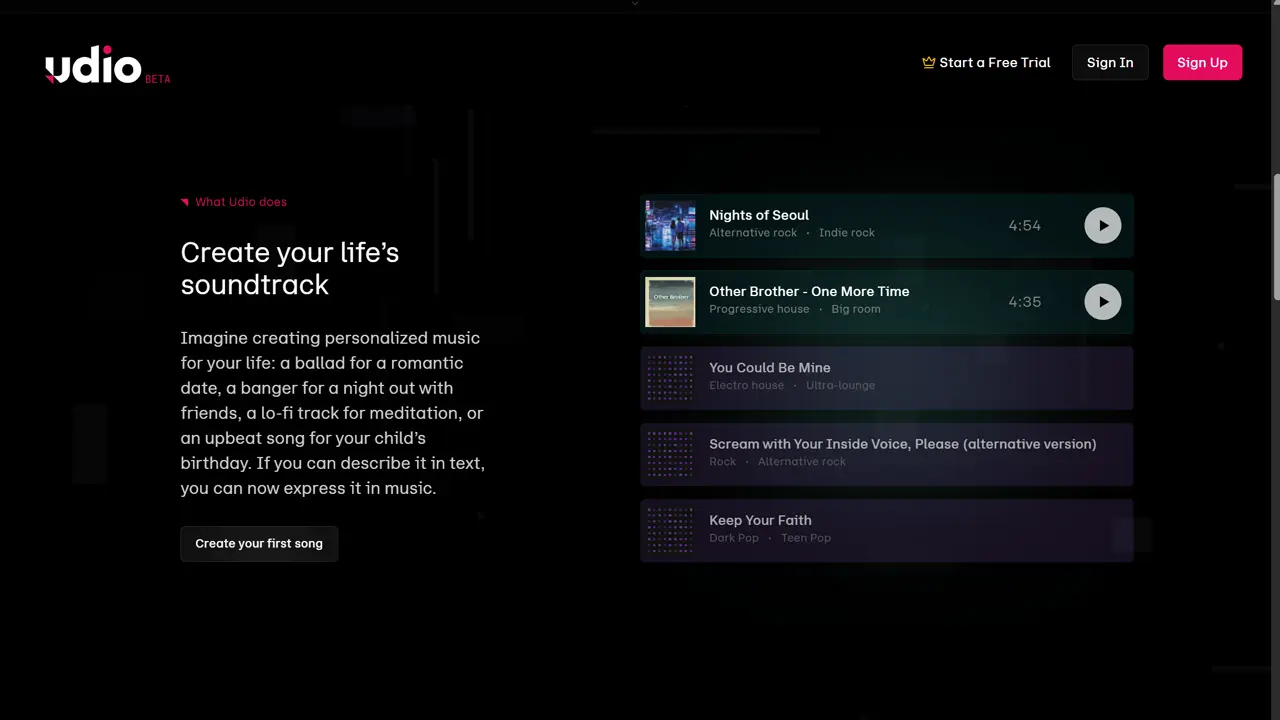
In hands-on use, Udio tends to produce more structured compositions with clearer musical progression. The trade-off is a slightly steeper learning curve compared to simpler tools.
Beatoven.ai
Beatoven.ai focuses on mood-based and context-aware music generation, particularly for video creators, podcasts, and games. Its interface resembles a simplified digital audio workstation, allowing users to adjust tempo, instrumentation, and structure while generating multiple variations from a single idea.

The platform emphasizes royalty-free usage and ethical training practices. While the production quality may not always match fully manual compositions, Beatoven.ai is often chosen for its clarity around licensing and ease of use in content-driven workflows.
Boomy
Boomy prioritizes speed and accessibility. Users select a style, generate a song within seconds, and can optionally add vocals or lyrics. Its workflow is designed for rapid creation rather than deep customization.

A distinctive feature is built-in distribution support, which allows creators to publish tracks to streaming platforms. While this makes Boomy attractive for beginners, reports of payout and account issues suggest it may be better suited for experimentation than mission-critical projects.
Starmony
Starmony takes a vocal-first approach. Instead of starting with text prompts, users record vocals directly, and the AI generates a complete musical arrangement around the performance.
This makes Starmony particularly appealing to singers and rappers who want fast results without complex setup. The main limitation is reduced flexibility for users who prefer instrumental-first or text-driven composition.
Mubert
Mubert operates more like an endless AI music library than a traditional composition tool. It excels at generating background music, ambient soundscapes, and continuous tracks for videos, apps, or live streams.
While it offers massive variety and API-based workflows, it is less suitable for users who need precise song structure, lyrics, or traditional verse-chorus arrangements.
AIVA
AIVA is one of the longest-established AI composition platforms. It supports a wide range of genres, from classical and cinematic scores to modern styles, and allows users to upload MIDI or audio references.
Compared to Suno, AIVA provides deeper compositional control but requires more time and familiarity with music production concepts. It is often favored for film, game, and orchestral projects rather than quick demos.
Why Look for Suno Alternatives?
Despite its popularity, Suno has several limitations that prompt users to explore alternatives. One of the most frequently cited concerns is legal uncertainty surrounding AI-generated music. Ongoing copyright disputes in the AI music space highlight potential risks for creators who plan to publish or monetize generated tracks.
From a practical standpoint, users also report creative inconsistencies. Generated songs may loosely follow prompts, repeat melodic patterns across genres, or produce unclear song structures and mispronounced lyrics. For casual experimentation this may be acceptable, but for professional or commercial workflows these issues often become blockers.
Additionally, some users express frustration with subscription management, customer support responsiveness, and unclear licensing terms. Taken together, these factors explain why many creators actively search for more reliable and specialized alternatives to Suno.
Suno vs Alternatives: Key Differences
- Creative control: Alternatives like Udio and AIVA offer more structured editing and arrangement options.
- Licensing clarity: Some platforms explicitly focus on royalty-free or commercial-safe outputs.
- Workflow focus: Tools vary widely, from instant generation (Boomy) to production-oriented composition (AIVA).
- Target users: Suno is often used for experimentation, while alternatives cater more directly to creators with defined use cases.
How to Choose the Right Suno Alternative
- Sound quality and style: Test whether the platform consistently delivers results aligned with your genre and expectations.
- Ease of use vs flexibility: Decide whether you value speed or detailed control more.
- Commercial usage: Carefully review licensing terms, especially if you plan to monetize the output.
- Unique features: Vocal input, image-based music generation, or direct distribution may be decisive factors.
- Platform reliability: Consider update frequency, transparency, and long-term viability.
Suno Popularity and Market Adoption
Suno is one of the most widely used AI music generation platforms in the consumer segment. According to Similarweb estimates, suno.com recorded approximately 70 million monthly visits worldwide, placing it among the most visited AI-driven creative tools.

Engagement metrics indicate sustained user interest rather than brief experimentation. On average, visitors spend nearly 8 minutes per session and view around 5–6 pages per visit, suggesting that users actively generate, review, and iterate on music rather than treating the platform as a one-off novelty.
Suno’s audience is globally distributed, with the United States accounting for roughly 20% of total traffic, followed by strong usage across Europe and large emerging markets. This broad international adoption helps explain both Suno’s rapid growth and the increasing attention it receives from professional creators and rights holders.
Suno Pricing and Plans
Suno uses a freemium pricing model designed to accommodate both casual users and more active creators. A limited free tier allows new users to experiment with AI music generation, while paid plans unlock higher usage limits and commercial rights.

The free plan provides a small daily allowance of generation credits, typically enough to create around 10 short tracks per day. This tier is mainly intended for experimentation and testing, with restrictions on advanced features and commercial use.
Paid subscriptions are structured around monthly credit limits and faster generation access. In practice, pricing usually falls into two main tiers:
- Pro plan — typically priced around $8–$10 per month, offering a higher monthly credit allowance, access to more advanced models, and the ability to use generated music commercially.
- Premier plan — generally in the range of $24–$30 per month, aimed at frequent users who generate music regularly and require larger credit volumes and priority processing.
Suno operates on a credit-based system, where each song generation consumes a portion of the available monthly or daily credits. Longer or more complex generations typically require more credits, which makes pricing relevant for users planning consistent or large-scale output.
As with many AI tools, plan details and limits may change over time. Users who intend to rely on Suno for professional or commercial projects are generally advised to review current subscription terms carefully before committing.
What Users Say About Suno
Public feedback on Suno is often polarized. Many users praise how quickly it can generate complete, listenable songs, while recurring complaints focus on reliability, support, and subscription-related frustrations.
These quotes reflect public user feedback and highlight common themes rather than universal outcomes.
Common praise:
“Suno is fully operational and easy to use with deeper more complex prompts and styles.”
Source: Reddit (r/aiMusic discussion)
“I consistently get a solid mix after 5–6 final generations.”
Source: Reddit (r/SunoAI thread)
“Stripping out all my notes from the Lyric Prompt tended to improve the audio significantly.”
Source: Reddit (r/SunoAI tips thread)
Common complaints:
“Signed up for their basic plan yesterday. As of today, cannot sign in or access the website.”
Source: Trustpilot review (www.suno.ai)
“Absolute shit and non existent customer care/support.”
Source: Trustpilot review (www.suno.ai)
“10 days after emailing to ask for a partial refund … and no reply. Customer support is non existent.”
Source: Trustpilot review (www.suno.ai)
Overall, users most often praise speed and surprisingly usable results, while the most frequent negatives relate to platform reliability, billing, and support. These themes map directly to why people compare Suno alternatives: more predictable control, smoother workflows, and clearer commercial readiness.
Legal and Practical Considerations
Using Suno involves several important legal and practical considerations, especially for creators who plan to publish, monetize, or distribute AI-generated music. While the platform provides clear usage rules at the product level, the broader legal framework around AI-generated music is still evolving.
Ownership and commercial use: Suno operates under a tiered licensing model. Music generated on the free plan is generally limited to personal, non-commercial use. Paid subscription plans grant users commercial usage rights for tracks created while an active subscription is in place. However, these platform-level permissions should not be confused with guaranteed copyright ownership under national or international law.
Copyright uncertainty: In many jurisdictions, works generated primarily or entirely by artificial intelligence may not qualify for traditional copyright protection, as copyright frameworks typically require human authorship. As a result, even when Suno allows commercial use, asserting exclusive legal ownership or registering AI-generated music may remain uncertain without meaningful human creative input.
Similarity and training concerns: Like other AI music tools, Suno has faced public and legal scrutiny related to how its models are trained and whether generated outputs could resemble existing copyrighted works. While users are generally permitted to use generated tracks, risks may increase if prompts or outputs closely mimic recognizable songs, melodies, or lyrical structures.
Subscription timing and usage scope: Commercial rights typically apply only to music generated while a paid plan is active. Tracks created under a free plan usually do not gain commercial rights retroactively after an upgrade, which makes subscription timing relevant for professional workflows.
Practical risk management: For low-risk use cases such as inspiration, demos, background music, or internal projects, Suno is commonly considered suitable. For higher-stakes commercial releases, creators often reduce risk by adding their own original lyrics, vocals, arrangements, or post-production work, thereby strengthening the human-authorship component of the final result.
Finally, users should be aware that platform policies, licensing terms, and legal interpretations may change over time. Reviewing current terms before relying on Suno for long-term or commercial projects is generally advisable, particularly in a legal environment that continues to develop alongside AI-generated content.
FAQ
Can I use Suno music commercially?
It depends on the plan and on when the track was generated. Suno typically restricts free-tier creations to personal, non-commercial use, while paid subscriptions generally include commercial usage rights for tracks created while your subscription is active. Even with commercial rights, broader copyright rules for AI-generated content can still vary by jurisdiction, so it’s wise to review current terms before publishing at scale.
Is Suno safe to use for YouTube monetization?
Many creators use Suno for YouTube content, but “safe” depends on how the track was made and how closely it resembles existing music. To reduce risk, avoid prompts that mimic recognizable songs, keep your workflow documented, and consider adding your own original elements (lyrics, vocals, arrangement edits, or post-production). For high-stakes channels, treat AI music as a starting point rather than a final master.
Do I own the songs I generate with Suno?
Suno’s platform terms usually define what usage rights you receive (personal vs commercial) and may differ by plan. However, platform permissions are not the same as guaranteed legal copyright ownership. In many places, purely AI-generated works may have limited copyright protection unless there is meaningful human creative contribution.
What are the main limitations of Suno compared to alternatives?
Common limitations include inconsistent adherence to prompts, occasional repetition across outputs, lyrics or vocal clarity issues, and less predictable song structure in some genres. Alternatives may offer stronger editing control, clearer licensing positioning, or workflows optimized for specific use cases like background music, vocals, or cinematic composition.
Which Suno alternative is best for vocals and lyric-based songs?
If your priority is vocal-driven output and clearer lyrical structure, tools that emphasize text-to-music with stronger control over lyrics and arrangement are often a better fit. In this guide, Udio is commonly considered a strong option for more structured, prompt-driven songs, while Starmony can work well for creators who prefer recording vocals first and letting the AI build the track around them.
Which Suno alternative is best for background music (videos, podcasts, games)?
For background tracks, many creators prioritize predictable mood control and licensing clarity over “radio-ready” vocals. Beatoven.ai is often a practical choice for content workflows focused on mood-based music, while Mubert can be useful when you need a large variety of ambient or continuous background sound rather than traditional verse-chorus songwriting.
How does Suno pricing work (credits)?
Suno typically uses a credit-based system where each generation consumes credits from your daily (free) or monthly (paid) allowance. Longer or more complex generations may consume more credits, so costs scale with how frequently you iterate and how much output you produce. If you generate music regularly, paid plans usually become more cost-effective than relying on the limited free-tier credits.
How can I reduce legal risk when using AI-generated music?
Avoid referencing identifiable songs or artists in prompts, and be cautious with melodies or lyrical phrasing that could be seen as derivative. Keep records of prompts and generation dates, and consider adding meaningful human input (original lyrics, vocals, arrangement changes, mixing/mastering) to strengthen authorship. For high-stakes commercial releases, a professional review may be reasonable depending on your risk tolerance.
Conclusion
Suno remains a popular entry point into AI music generation, particularly for experimentation and rapid song creation. Its scale and accessibility make it appealing to a broad audience, but limitations related to creative control, licensing clarity, and legal uncertainty explain why many users explore alternatives.
Tools like Beatoven.ai, Udio, Boomy, Starmony, Mubert, and AIVA address different creative needs, from background music and vocal workflows to more structured composition. Choosing the right solution depends less on raw popularity and more on factors such as intended use, commercial requirements, and tolerance for legal or platform-related risk.