ElevenLabs is an AI voice platform best known for realistic text-to-speech and voice cloning, commonly used for narration, audiobooks, product videos, and localized voiceovers.
This page reviews the most relevant ElevenLabs alternatives for AI voice cloning and speech, highlighting where they differ in voice quality, language support, editing workflow, licensing and compliance posture, and pricing approach, so you can quickly shortlist the tool that fits your content type and risk tolerance.
Popular ElevenLabs Alternatives
This article highlights the most relevant alternatives. The full list of tools and category overview are available in the main ranking below.
Resemble AI
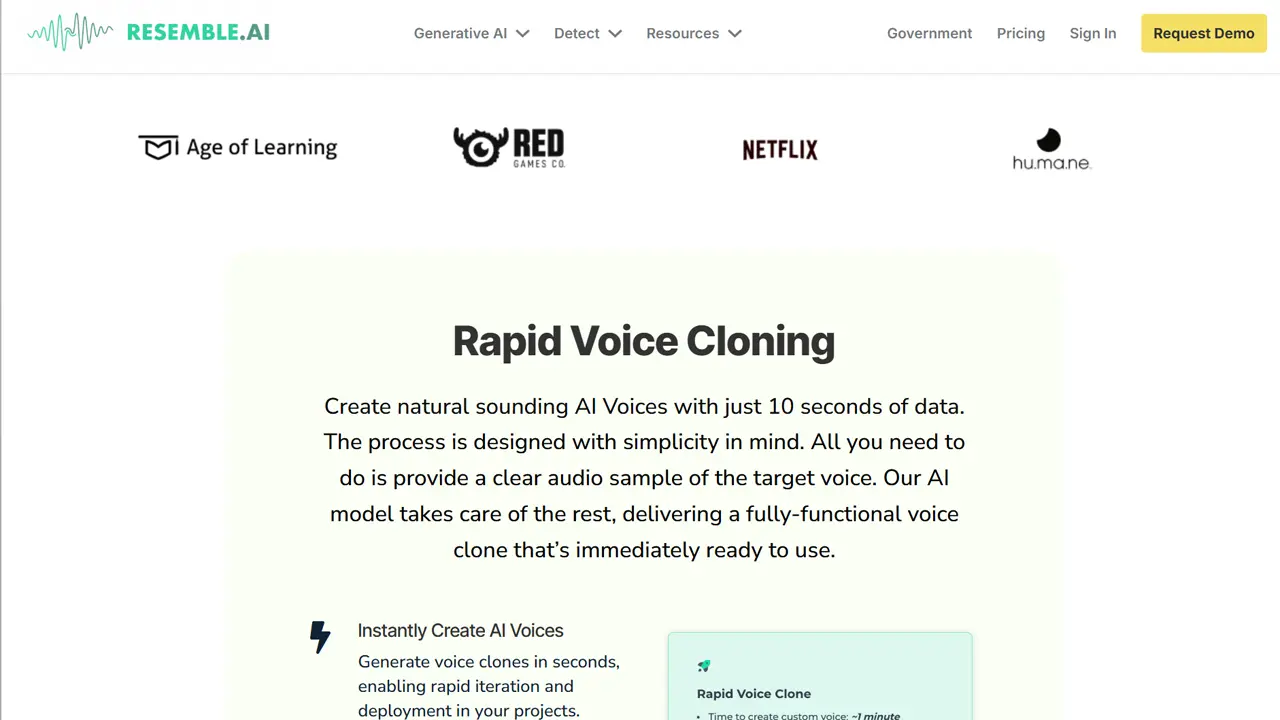
Resemble AI is a close substitute for ElevenLabs when you need realistic text-to-speech plus custom voice cloning in a product or production pipeline. It also emphasizes API-first workflows (including speech-to-speech options) and features like watermarking for provenance, but setup and tuning can feel more “platform-driven” than a simple creator studio in some scenarios.
MiniMax
MiniMax (MiniMax Audio) is a strong ElevenLabs alternative if you want multilingual text-to-speech plus voice cloning in a more API-oriented setup. It’s a practical fit for teams building voice features into apps (batch generation, programmatic control, scalable delivery) and for creators who mainly need high-quality narration output rather than a full “voiceover studio” workflow. As with any cloning-capable platform, you’ll still want to validate its consent requirements, commercial licensing terms, and how it handles voice replication safeguards for your specific use case.

Murf AI
Murf AI is frequently considered alongside ElevenLabs for voiceover production and supports voice cloning for consistent narration. Compared to a voice-first TTS tool, Murf can feel more like an end-to-end “voiceover studio” (script, timing, and export), which is helpful for structured content, but less minimal if you only need fast generation.

LOVO AI (Genny)
LOVO AI (Genny) is a practical replacement when your workflow is “write a script, generate a voiceover, optionally clone a brand voice,” with a creator-friendly production focus. It offers voice cloning with relatively low friction, but the trade-off versus ElevenLabs can be in how much fine-grained control you get over a single voice model versus relying on a broader studio-style workflow.
Descript Overdub
Descript Overdub overlaps with ElevenLabs on voice cloning, but it is built primarily for editing and patching spoken audio by editing text (podcasts, interviews, and video narration). It can be the better “replacement” when your main problem is fixing or updating recordings without re-recording, while it may be less direct if you need a dedicated TTS platform for large-scale generation.
Why Look for ElevenLabs Alternatives?
Users usually search for ElevenLabs alternatives for practical reasons tied to workflow, budget, and risk management. One common driver is pricing or usage limits: teams producing frequent voiceovers, long-form narration, or multi-language content may want a different cost structure, higher included minutes, or more predictable scaling. Another reason is feature fit—for example, some tools focus more on studio-style production (timing, script editing, and exports), while others are better for API-based generation, real-time speech-to-speech, or audio post-processing in a single workspace.
There are also quality and control considerations. Depending on the language, accent, speaking style, or the need for consistent character voices, users may prefer a provider that performs better for their specific voice profile or offers different controls for stability, expressiveness, and pronunciation. Finally, many comparisons come down to compliance and permissions: organizations may need stricter voice consent workflows, clearer licensing terms for commercial use, or vendor options that align better with internal policies for synthetic voice and impersonation risk.
ElevenLabs vs Alternatives: Key Differences
ElevenLabs and similar AI voice tools are usually compared on a few practical criteria that directly affect output quality, production speed, and operational risk. The biggest separator is often voice realism and consistency—how stable a cloned voice stays across long scripts, how well it handles emphasis, and how reliably it pronounces names, brands, and domain-specific terms.
Workflow design is another key difference. Some products are essentially a TTS/voice engine (generate, iterate, export, or call via API), while others focus on a broader studio experience (editing, collaboration, and packaging voice into media). Depending on your use case, you may value fast batch generation and APIs more than UI convenience—or the opposite.
Other common decision factors include language and accent coverage, controls for style/pacing/pronunciation, and API reliability (latency, streaming, concurrency, and voice/model versioning). Finally, policy and compliance varies across providers—consent requirements, anti-impersonation safeguards, moderation rules, and commercial licensing terms can be as important as audio quality when you publish at scale.
How to Choose the Right ElevenLabs Alternative
Step 1: Define your primary output and constraints. Start with the end product: short marketing voiceovers, long-form narration, character voices, in-app speech, or podcast/video editing. Note must-haves such as required languages/accents, target platforms (web, mobile, studio export), and whether you need an API or only a web interface.
Step 2: Separate “voice cloning” from “text-to-speech” needs. If you need a consistent custom voice (brand voice, character voice, creator voice), prioritize cloning quality and stability over long scripts. If you mainly need fast voiceovers in many styles, evaluate the voice library, speed of iteration, and editing workflow first.
Step 3: Run a controlled audio test with your real scripts. Use the same 30–60 second script across candidates, including the words that typically break TTS (names, numbers, acronyms, punctuation). Compare (a) naturalness, (b) consistency across multiple generations, (c) pronunciation controls, and (d) how much manual editing you need to reach “publishable” quality.
Step 4: Check workflow fit for your production process. If you work in teams, look for collaboration features, versioning, and repeatable templates. If you build products, prioritize API quality (streaming, latency, reliability, quotas, and voice management). If you edit spoken content, consider tools that integrate voice generation into an editor rather than a standalone generator.
Step 5: Verify permissions, licensing, and safeguards. Confirm what the provider requires for voice consent, what commercial rights you receive, and what restrictions apply to sensitive use cases. If you work with client voices or public figures, choose the option that best supports documented permissions and reduces impersonation risk.
Step 6: Compare pricing against your real usage pattern. Estimate monthly volume (minutes, characters, or credits) and stress-test costs for peak months. A slightly lower per-minute price can be less valuable than a plan that matches your workflow (predictable limits, team seats, or API-friendly scaling).
ElevenLabs Popularity and Market Adoption
The Similarweb snapshot for Dec 2025 suggests ElevenLabs operates at meaningful scale, reflecting broad demand for AI speech and voice workflows. These figures are best treated as directional signals of overall usage rather than exact adoption or feature-level consumption. In Dec 2025, elevenlabs.io recorded about 27M visits worldwide (up roughly 15% month over month), with usage split across both desktop and mobile web.

Engagement patterns also look consistent with repeat, task-oriented behavior: users spend several minutes on the site and view multiple pages per session, which typically aligns with workflows like generating audio, iterating settings, and managing voices or projects. Demand appears globally distributed, led by India and the United States. Acquisition is driven mainly by Direct and Organic Search, while YouTube stands out within social—often a sign that people discover the product via demos and then return directly to get work done.
ElevenLabs Pricing and Plans
ElevenLabs uses a tiered subscription model built around monthly credits. Credits are consumed when you generate audio (text-to-speech and related features), and paid plans can optionally continue beyond the included quota via usage-based overages. Credit allowances reset each billing cycle, and unused credits on paid subscriptions can roll over for a limited time (as described in their pricing FAQ).
-
Free — $0/month, includes 10k credits/month (intended for light testing and basic use).
-
Starter — $5/month, includes 30k credits/month and adds practical “work” permissions such as a commercial license and instant voice cloning.
-
Creator — listed as $22/month (with a first-month discount shown as $11), includes 100k credits/month and adds professional voice cloning plus higher-quality audio options.
-
Pro — $99/month, includes 500k credits/month and adds more advanced output options (including higher-fidelity formats via API).
For higher-volume teams, ElevenLabs also lists business tiers such as Scale ($330/month, 2M credits) and Business ($1,320/month, 11M credits), which primarily expand capacity and team capabilities rather than changing the core workflow.

-
Usage limits and unit economics: higher tiers mainly increase included credits (and may change how far those credits go depending on the selected model and any discounted credit rates).
-
Licensing and cloning capabilities: entry paid tiers typically unlock commercial usage and cloning features; higher tiers may add more advanced cloning options and broader operational use.
-
Quality, formats, and team features: plans can differ in available audio quality/output formats (especially via API) and collaboration features like seats/workspaces.
Note: pricing, included quotas, and plan feature definitions can change over time, so treat any plan comparison as a snapshot and verify details in the current ElevenLabs Pricing and Pricing FAQ pages before committing.
Source: ElevenLabs official Pricing page and Pricing FAQ.
Legal and Practical Considerations
What ElevenLabs allows under its terms and policies
ElevenLabs frames voice cloning as a permission-based workflow: when creating a clone, users are expected to confirm they have the rights and consent to use the voice samples. The platform also publishes prohibited-use rules aimed at preventing harmful or unlawful outputs (including certain types of impersonation and IP misuse) and describes safeguards for higher-risk scenarios.
What may still be legally disputed or unclear
Even if a platform permits a workflow, legality can still depend on jurisdiction and facts. Voice cloning may raise right of publicity concerns (commercial use of identity), privacy/consent issues, consumer protection risks (misleading or deceptive audio), and sometimes copyright-adjacent questions around performances. In practice, disputes often center on whether the output implies endorsement, causes confusion, or leverages a recognizable identity without permission.
Practical pitfalls users run into
-
Consent gaps: if you cannot document who provided the sample and what they agreed to (scope, channels, duration, revocation), commercial use becomes harder to defend.
-
Impersonation exposure: “close enough” voices can create reputational and legal risk, even when the intent is parody, demos, or internal testing.
-
Policy changes: providers may tighten enforcement, add checks, or restrict certain voices and use cases, which can break workflows that rely on specific clones or automation.
-
Downstream platform rules: ads networks, app stores, and social platforms may require disclosures or prohibit certain synthetic-media scenarios even if generation is allowed.
Public discussion and real-world risk
Synthetic voice tools are regularly referenced in public reporting about misuse and alleged unauthorized imitation. You should treat this as a signal to implement stronger consent, review, and disclosure practices—especially when content could be mistaken for a real person.
Practical risk management
Use voice cloning only with written, auditable consent that defines allowed uses (commercial/non-commercial, channels, duration, and revocation). Avoid voices that could be reasonably perceived as a specific real person unless you have explicit authorization and a defensible purpose. For higher-stakes projects, keep source-audio records, label synthetic outputs internally, and validate local requirements (publicity, disclosure, consumer protection) before wide distribution.
Sources (for further reading): ElevenLabs Terms of Service; ElevenLabs Prohibited Use Policy; ElevenLabs Help Center (voice cloning restrictions and safeguards).
What Users Say About ElevenLabs
User feedback on ElevenLabs is often mixed: many people praise the realism and speed, while others focus on cost predictability, credits, and edge-case reliability in longer projects.
Positive feedback
“What I like best is the incredibly realistic and natural-sounding voices.”
Source: G2 review (Aman V., Aug 5, 2025)
“It's a hobby, and I think paying 22-30 bucks a month on my hobby is fair.”
Source: Reddit (r/ElevenLabs thread “Creator Package: Is It Worth It?”, 4 months ago)
“Its so easy to clone your voice; simply upload an audio file of 10 seconds or more and get an exact replica.”
Source: SoftwareSuggest review (Jones M., Feb 10, 2025)
Negative feedback
“The biggest downside for me is the credit-based pricing. It's easy to run out of my monthly character limit.”
Source: G2 review (Aman V., Aug 5, 2025)
“Eleven labs is so much over priced and overrated. Not the most expressive but definitely the most expensive tts ever!”
Source: Reddit (r/singularity thread about Eleven v3 alpha, 7 months ago)
“I paid $250 for an annual plan. The files are incompatible with ACX/Audible.”
Source: Trustpilot review (TwoBuddhas, Updated Dec 22, 2025)
Across sources, the most consistent positives are voice realism and how quickly users can produce usable voiceovers, which matters when time-to-publish is the main constraint. The most repeated negatives cluster around credit-based costs (budget predictability for long-form or iterative work) and fit for specific distribution requirements (for example, audiobook platform rules). In practice, this usually means alternatives look most attractive when you need steadier economics at scale, tighter editing workflows, or a workflow tailored to a particular publishing channel.
FAQ
Is ElevenLabs mainly text-to-speech, voice cloning, or both?
Both: you can generate speech from text using built-in voices, and you can also create a custom cloned voice from audio, depending on your plan and account feature access.
How much audio do I need to clone a voice well?
More clean, consistent audio usually produces better results. Short samples can work, but stable long-form narration typically benefits from higher-quality recordings with minimal noise and a consistent speaking style.
Why does the same script sound different on different generations?
Small variations are normal in generative speech. For consistency, keep punctuation and settings stable, add pronunciation guidance where needed, and iterate on small sections instead of regenerating everything.
How do credits typically get consumed?
Most plans spend monthly credits when you generate audio. Consumption depends on output length and quality/model options, so test your typical script to estimate monthly needs.
Can I use ElevenLabs output commercially?
Commercial use depends on your plan and the current licensing terms. For client work or monetized content, confirm permissions and keep documentation that you have rights and consent for the voice used.
What are common reasons a voice clone sounds “off”?
Common causes include noisy or heavily compressed input audio, style mismatch, or tricky text (names, acronyms, numbers). Cleaner source audio and simple pronunciation hints usually improve stability.
When should I consider an ElevenLabs alternative instead?
If you need more predictable costs for long-form content, a stronger editing/production workflow, specific export requirements (for example, audiobook standards), or stricter compliance controls, an alternative may be a better fit.
Conclusion
If you’re comparing ElevenLabs alternatives, the most reliable way to choose is to match the tool to your real workflow rather than “best demo” voice quality. ElevenLabs shows strong market traction, and many users value its natural-sounding output and fast iteration, but common friction points include credit-based cost predictability for long-form or highly iterative work and occasional mismatch with specific publishing requirements (especially audiobook-style pipelines).
A good alternative is usually the one that removes your bottleneck: pick an API-first provider for product integration and scale, a studio-style tool if you need scripting, timing, and exports in one place, or an editor-centric option if you mainly patch and update spoken audio. Whichever route you choose, treat voice cloning as a permissions-first workflow—keep auditable consent records, test with your exact scripts and edge-case terms, and confirm output requirements before committing to a higher tier.